
Common Customer Questions About Our Capabilities at UCGTR
At United Centerless Grinding & Thread Rolling, we always want to help customers move into production as easily as possible. But with new customers, it’s important to start the process by answering any questions they have about our capabilities, certifications, and more.
To simplify some of those initial conversations and help you determine whether our shop is a good fit for your project, we’ve compiled answers to some of the most common questions we receive from customers.
But we know that most projects will require questions specific to your needs as well; if you don’t see your question in this list, contact us to discuss!
What Capabilities Do You Have at United Centerless Grinding & Thread Rolling (UCGTR)?
We offer a range of precision manufacturing services, including:
With all of these capabilities in house, we can support many different aspects of your manufacturing process and simplify your project. For example, if a Swiss-machined part requires tighter tolerances than turning can achieve, we can rough the blank oversize and then finish grind it using our centerless grinding capabilities.
What Is Centerless Grinding?
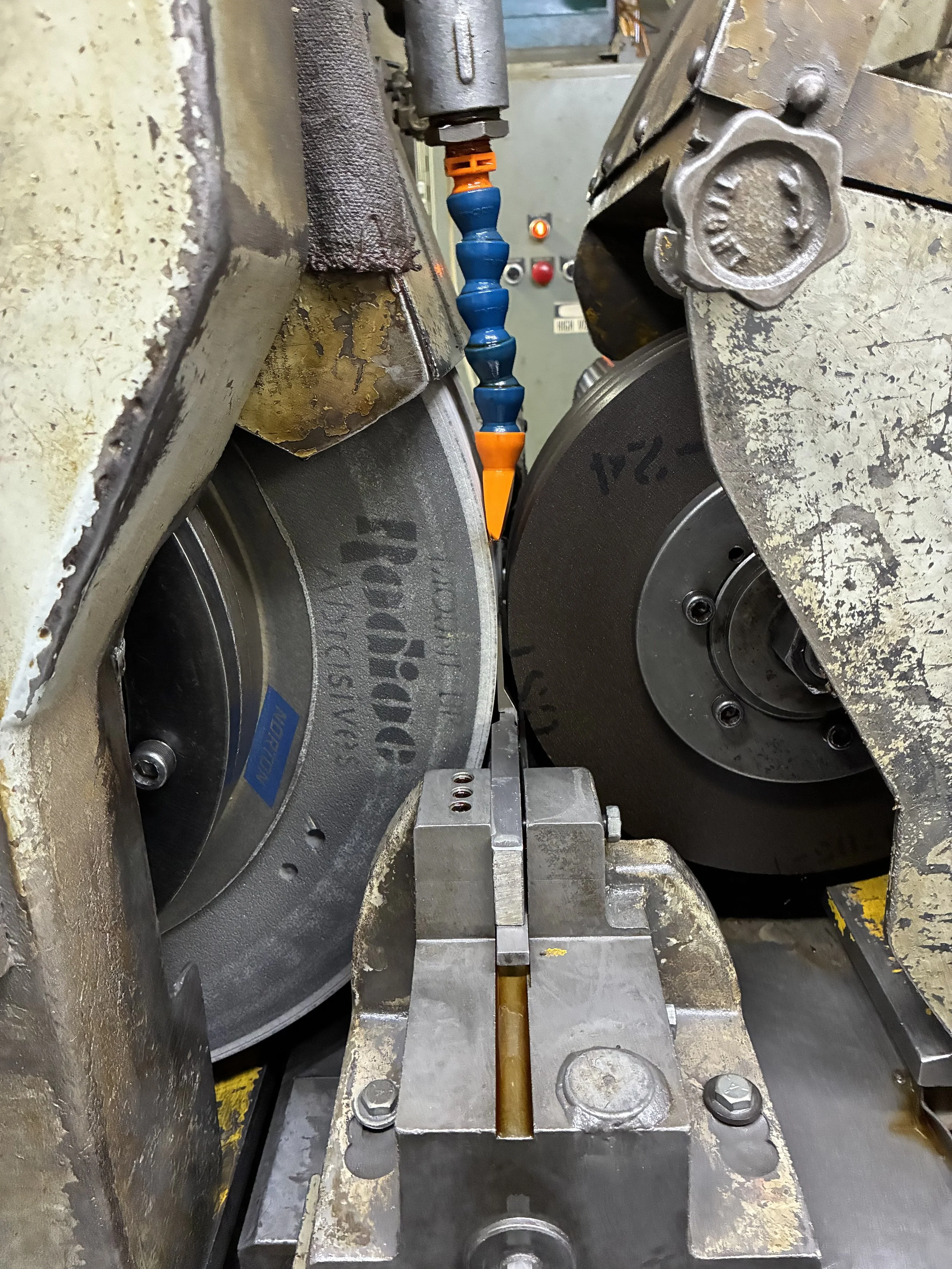
Centerless grinding is a machining process used to remove material from the outside diameter of a cylindrical part. Unlike other grinding methods, the part is not held between centers or clamped in place. This makes centerless grinding especially useful for production work and higher volume projects.
Which Is Right for My Project: Centerless Grinding or OD Grinding?
If a feature must be controlled precisely to the centerline of the part, OD grinding may be required; otherwise, centerless grinding is often the best fit for tight tolerance cylindrical parts.
We do not offer OD grinding at UCGTR, but we can help you evaluate your print to determine the most effective process.
What Types of Centerless Grinding Are Available at UCGTR?
We offer thru-feed grinding, in-feed grinding (which we also refer to as plunge grinding or end-feed centerless grinding), bar grinding, crush grinding, and form grinding. Each method offers benefits for different part geometries and production needs.
We offer more information about each option in our glossary, but customers do not need to determine the right technique before contacting us. Our team will review your part requirements and recommend the most effective process for the project.
Does My Project Require Crush Grinding?
Customers sometimes request crush grinding by default because it’s the process they’re most familiar with. We do offer crush grinding, but it’s not always the most cost-effective option. We’ll discuss your project to help you find the right grinding technique without adding unnecessary costs.
What Range of Part Sizes Can You Handle?
For centerless grinding, United can grind parts up to 5.5 inches in diameter, with very small diameters possible depending on the application.
In bar grinding, we can handle bars up to 5.500 inches in diameter and 30 feet long but have a weight limitation of 1000 lbs.
For thread rolling, we can produce threads from very small sizes (starting at #0) up to 1-1/8 inches in diameter. Length-to-diameter ratio is important, so larger thread diameters may have length limitations. We recommend contacting our team to review the specs if you think your part may be on the high end of the range.
Can You Thread Parts With an ID or Hole?
Yes, in most cases. As a general guideline, the wall thickness between the thread’s minor diameter and the ID should be greater than ⅛ inch. In some smaller parts, thinner walls may be possible.
What Materials Does United Centerless Grinding and Thread Rolling Work With?
We work with a wide range of materials.
Metals such as stainless steel or aluminum are common, but we’ve also worked with plastics, ceramics, wood, stone, and hard or exotic metals. Because we often support unique projects, we are open to new or challenging materials.
What Are Your Hardness Limitations for Thread Rolling?
For thread rolling, our general maximum is 38 Rockwell C. In some cases, we may be able to work with harder materials, but those projects need to be reviewed on a case-by-case basis.
What Lot Sizes Do You Accept?
We accept low, medium, and high-volume projects. We’ve taken orders with quantities as low as one and as high as one million.
We’re On a Tight Budget. Can You Help Us Keep Costs Low?
We do everything we can to help you keep costs low, including by handling more steps in-house and helping you determine the most efficient grinding technique for your part.
For high volume projects in particular, we can help in a variety of ways. We reduce cost by designing efficient processes through feed systems, tooling, and engineering, and we also automate steps where we can. Before production begins, we can offer design-for-manufacturing (DFM) recommendations that can make parts easier (and more cost-efficient) to manufacture.
Can You Provide First Article Inspection Documentation?
Yes, we can perform first article inspections and supply first article inspection documentation per AS9102 or your particular specification when required.
Can UCGTR Manage the Destructive Lab Testing Process for Our Parts?
Yes, we coordinate destructive lab testing through our trusted vendor network.
In addition, we have an internal test lab to perform preliminary testing before parts are sent out. This initial testing can identify potential issues early, which prevents unexpected failures that could add cost and lead time to projects.
What Is the Smallest Radius You Can Hold in Centerless Grinding?
We can hold radii as small as .002”.
What Surface Finishes Can United Centerless Grinding and Thread Rolling Achieve?
We can achieve surface finishes as fine as 6 microinches Ra, depending on the part and application.
Can You Achieve a 32 Microinch Ra Surface Finish on Rolled Thread Flanks?
Yes. A 32 microinch Ra surface finish is a common requirement on rolled thread prints, and our tooling is designed to meet that standard.
What Tolerances Can You Hold?
We work on tight-tolerance projects regularly in our shop. Our capabilities include:
Centerless grinding: tolerances as tight as 0.00005" total
Wire EDM: tolerances as tight as ±0.0001", or 0.0002" total
Swiss machining: tolerances as tight as 0.0002" total, depending on the part geometry
What Are Your Inspection Capabilities?
We only take on projects we know we can verify. Our equipment includes optical comparators, Keyence and Starlite vision systems, mitutoyo CMM, micrometers, indicators, and more. Our gauging equipment is maintained and calibrated on a regular schedule in line with our ISO requirements.
What Are Your Certifications?
United Centerless Grinding & Thread Rolling is:
ISO 9001 certified
ITAR registered
PWA 96 certified
PWA 106 certified
In addition, we are actively looking to achieve Nadcap certification for our EDM department.
Ask Us Anything
If your question isn’t covered in this blog, let’s discuss! We offer a wide variety of capabilities, and we can help you evaluate the best option for your part.
Contact our team to discuss your needs!