
When to Choose Crush Grinding, and When You Don’t Need It
When customers reach out to our shop for grinding, it’s common for them to ask for crush grinding in their RFQ. Sometimes it’s the method they’re most familiar with; other times it’s what a previous supplier used on a similar project. As a result, it’s their starting point when they request a quote.
At United Centerless Grinding and Thread Rolling, we’ll always quote crush grinding if it’s the right fit. But we’ve found that it can add avoidable cost without improving your outcome. That’s why we follow up with more questions about your project: we want to help you find the best grinding technique for both your part needs and your bottom line. And that may be something other than crush grinding.
Below is a practical overview of our most common grinding methods, with some information on when crush grinding is the best choice.
What Is Crush Grinding?
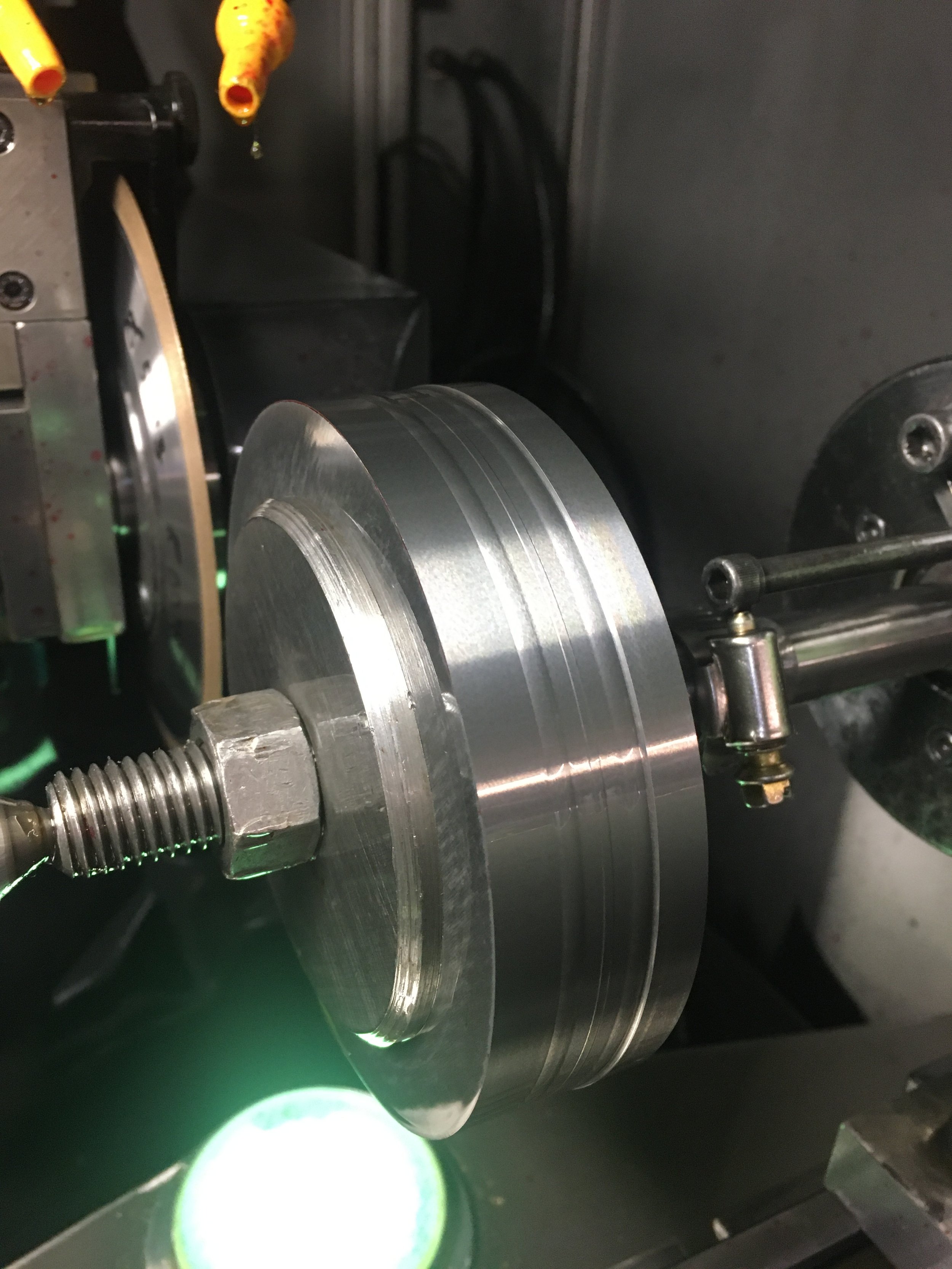
Crush grinding is a form of in-feed centerless grinding where a hardened crush roll is used to form a profile into the grinding wheel. When the crush roll contacts the wheel, it compacts the wheel and transfers the geometry into the wheel face. Once the wheel has that form, it can plunge-grind the part to the required geometry.
In many cases, crush grinding isn’t the most cost-effective option. That’s because crush rolls often need to be custom-made to match your part geometry, and they may be manufactured from hardened materials like carbide. As a result, tooling cost and lead time can increase.
Plunge Grinding: Great for Simple Forms
In plunge grinding, a part is loaded into the machine, and the wheel grinds to size without the part traveling through continuously. This is often ideal when the geometry is simple enough that it doesn’t require a crush roll, such as in a straight-diameter part. Similarly, when your part has a shoulder feature that prevents through-feeding, plunge grinding is frequently a cost-effective solution.
Some less complicated forms can be made without a custom crush roll by using a combination of cams, followers, and diamond tools to shape the grinding wheel. For example, we may use our wire EDM machines to make a cam that may have two or three different features on it, such as a diameter into a fillet radius into an angle. The follower has a diamond tool on the end nearest the grinding wheel, and that diamond tool cuts the form into the grinding wheel. As the follower follows the shape of the cam, the diamond tool mimics the shape and creates the form that will then grind into the part.
Through-Feed Grinding: Long Runs of Straight Diameters
In through-feed centerless grinding, parts enter on one side of the machine, pass through the wheel/work-rest gap, and exit. It’s typically used for single, continuous diameters. It’s often the most efficient approach for high-volume work.
Profile Grinding
Beyond centerless grinding, we also offer OD profile grinding for parts that require complex shapes that aren’t ideal for centerless processes. Profile grinding is typically used to create or follow complex shapes. At our shop, we have both manual and CNC profile grinding. Manual profile grinding at UCGTR is a precision process; using high magnification, our expert team follows the part’s profile closely to achieve the required geometry with consistent accuracy.
When Is Crush Grinding the Right Choice?
Crush grinding can be the most cost-effective option in certain situations, although it requires fairly specific conditions. For instance, crush grinding can be a strong fit for high-volume parts with multiple features where forming the wheel only once saves cycle time and handling.
Within our shop, that is a small fraction of jobs. But when it does fit, it can reduce the cost per unit significantly. For example, we produce very high-volumes of a set of pins that have a three-inch long section with seven features on it. Without a crush roll, those seven features would be ground individually, which adds significant time at high volumes. But with a crush roll, the full geometry can be produced in a single operation. Setup time is longer up front, but per unit price decreases meaningfully.
Our Commitment: The Best Process for Your Part
If you ask us for crush grinding, we’re happy to perform it, but we always want to make sure it’s necessary first. We’ll review your geometry, tolerances, finishing requirements, and volume, and then recommend the method that delivers the results you need at the best value. That’s our commitment at the shop: to do everything we can to help you get effective parts that protect your project’s bottom line.
Request a quote from our precision grinding company, and we’ll help you find the most efficient approach for your parts!